A Ten-Minute Drawing from One Household Object
A ten-minute drawing from one household object trains your eye to compare outline and proportion before detail, using only paper and an ordinary pencil.
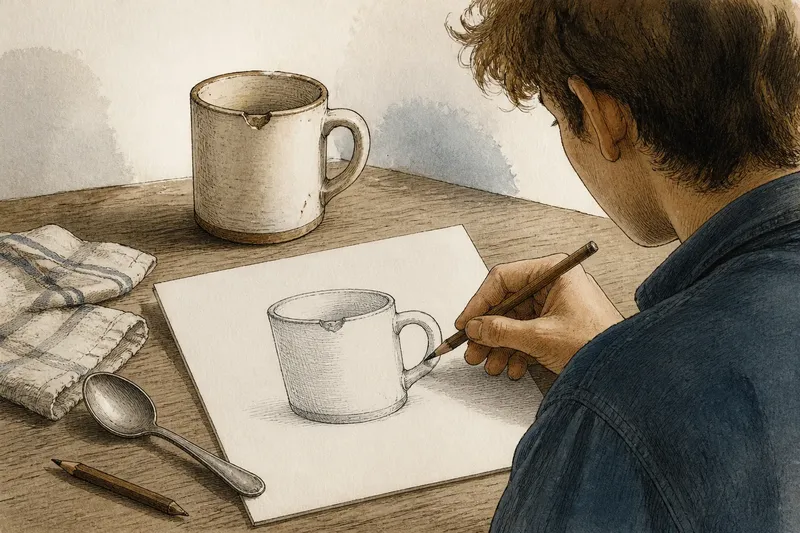
A ten-minute drawing from one household object is less about making a likeness than noticing how its parts fit together. Put a mug, spoon or folded tea towel on a table, take any pencil and scrap paper, and begin with the outside shape. Details can wait; they are very good at keeping a hand busy while an eye drifts elsewhere.
Imagine a student called Rowan sitting down after lunch with a chipped ceramic mug, a blunt pencil and the back of an envelope. Rowan has no drawing practice in mind and no reason to produce a keepsake. The aim is simply to look at one object long enough to make a few decisions about its shape.
Choose a cooperative object
Rowan chooses the mug because it is still, familiar and easy to place on the table. A household object need not be picturesque. It helps if its outline can be seen clearly against what lies behind it, and if it will stay put while you draw.
A mug offers a body, a rim and a handle, so the eye has something to compare. A lemon gives a less regular outline. A wooden spoon has a long axis and a shallow bowl. For this exercise, avoid objects that are transparent, highly reflective or crowded with small parts; their visual complications can take over before the basic shape is established.
Rowan moves the mug a little away from the wall, leaving a plain patch behind it. The handle points to the right. That small choice matters: turning an object changes its outline, and the drawing records the view from one particular place, not the object in every possible view.
Set the viewing position
Rowan sits rather than standing over the table, with the mug below eye level. From there, the top of the rim appears as a shallow oval. Looking from above would make the opening look rounder and expose more of the inside. Neither view is more correct; the useful one is the view Rowan can hold steady.
Keep the object and paper in a comfortable arrangement. Look from the object to the page, then back again. If you keep shifting your head or moving the mug, comparisons become harder. There is no need to mark a formal boundary around the drawing area, but leaving room around the object helps prevent the handle or base from being pressed against the edge of the paper.
Rowan takes a moment to notice the general direction of the mug’s body and where the handle attaches. These are not measurements. They are visual relationships: the body is taller than it is wide, the opening sits above the middle, and the handle reaches out from one side.
Draw the outer shape
With the pencil held lightly, Rowan makes a few tentative strokes for the mug’s main body. A faint line is easy to adjust; an emphatic outline can make an early guess feel like a ruling. Rowan checks the width against the height by looking back and forth, then shifts one side of the shape inward.
The first outline does not need to be continuous. Short, searching marks can describe a curve more freely than one cautious line. Rowan pays attention to the shoulders of the mug, where the body begins to narrow towards the base, and leaves the handle out for the moment. The point is to establish the largest shape before asking smaller forms to sit on it.
Now Rowan adds the rim as an oval. The far edge is partly hidden by the near edge, so the opening is not drawn as a complete, equally strong loop. This is a useful reminder: an outline is not a symbol for “mug”. It follows what can actually be seen from the chosen position.
Check the proportions
Rowan pauses and compares a few landmarks: the top of the rim, the bottom of the base, the widest part of the body, and the handle’s outer reach. The drawing looks slightly squat. Rather than erase everything, Rowan asks which relationship seems most off. The rim sits too close to the base, so the body is lengthened with a light adjustment.
This kind of comparison is more useful than asking whether the drawing looks good. A quick drawing can be lopsided and still show careful looking. Check whether the handle begins at the same heights as its attachment points on the mug, whether the opening is centred over the body, and whether one side curves differently from the other. Household objects are often close to symmetrical, but a particular view, a thick rim or a handmade surface may complicate that expectation.
Rowan glances at the actual mug, not at an imagined ideal mug. The left side is a little fuller than the right from this angle. Rowan keeps that difference instead of correcting it into a tidy symbol. The small irregularity makes the drawing more specific.
Add only useful details
With the larger relationships in place, Rowan draws the handle as a broad loop, checking the empty space inside it as carefully as the ceramic around it. That gap is a shape too. Treating it as one helps the handle avoid becoming either too thick or too narrow.
Only then does Rowan add the chipped spot on the rim and a short line for the shadow inside the mug. Each detail is included because it clarifies this object or this view. There is no need to shade every surface. A few quiet marks can suggest the opening and the place where the base meets the table without turning the exercise into a study of pencil technique.
If the outline still feels unsettled, stop adding detail and look again. A pattern, logo or decorative mark can be drawn later, but it cannot repair a body whose width and height do not relate as they appear to. The order is practical: large shape, proportion, then selected particulars.
What can go wrong?
What object should I draw?
Choose something stable with a visible outline, such as a mug, fruit or wooden spoon. A plain background and a clear view make it easier to compare the object’s main shapes.
Do I need to draw from memory?
No. Keep looking at the object and let the page record the view in front of you. Drawing from memory is a separate exercise, and it asks for a different sort of attention.
What if the drawing looks wrong?
Look for one relationship to adjust, such as the height of the body or the width of the opening. Avoid rubbing out the whole drawing at once; a small correction can teach you more about what you saw.
Should I finish with shading?
Only if the outline and proportions already feel clear. A small shadow or dark opening can help describe the form, while elaborate shading may distract from the purpose of this short session.
Leave a useful record
When Rowan stops, the mug is recognisable, though the handle is a little uneven and the base tilts. The result is not a polished picture. It is a record of which shapes Rowan noticed, which comparisons helped, and where the first guess needed changing.
That is enough for one sitting. Rowan writes “wider rim” beside the drawing, not as a verdict but as a note for another look. A ten-minute drawing from one household object can end with a page that is rough and useful at once: the next time Rowan sees a mug, the oval at its top may be harder to mistake for a simple line.