The Hidden Symbol Trap: When a Detail Is Just a Detail
Learn how to read repeated objects in art without inventing secret meanings, using visible evidence to separate observation from interpretation.
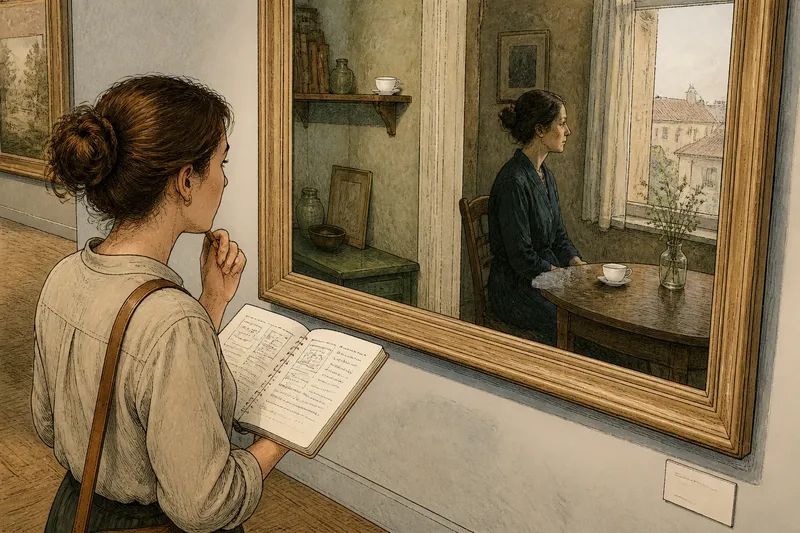
A painted dog does not become a symbol simply because it appears twice. Repeated objects attract attention, but attention is not proof of a hidden message. The useful question is not only what an object might mean, but what the artwork gives you reason to think it means.
That distinction matters because looking at art involves two different acts. First, you notice what is there. Then you interpret why it might be there. Those acts can inform each other, but they are not interchangeable. A careful reading keeps the evidence visible while letting an interpretation remain provisional.
What counts as evidence?
Evidence is something another viewer could point to in the artwork or in reliable information about its making and context. It might be the object’s placement, its relation to a figure, a striking change in colour, or the way it recurs. “The bird is painted near the window” is an observation. “The bird represents freedom” is an interpretation.
The second claim may be plausible. It is not yet established by the first. A viewer can make a useful note by separating the two: write down the visible detail, then name the thought it prompted. This small pause prevents a familiar image or association from quietly posing as fact.
Evidence can also come from the work’s title, an artist’s statement, a catalogue entry, or documented information about its original setting. Such sources do not settle every question, but they can narrow the field. A title might identify an object or event; it does not necessarily explain every choice in the image.
There is a difference between an interpretation supported by several features and a story that depends on one suggestive detail. If a red fruit sits beside a figure, colour and position are visible. A claim about temptation, mortality, or a private code needs more support than the fruit alone.
Why does repetition attract meaning?
Repetition is conspicuous because the eye notices patterns. When an object appears in several parts of a picture, viewers naturally ask whether the recurrence connects those parts. That is a sensible question, not a licence to assume the answer.
The object might link figures, balance a composition, establish rhythm, or mark a practical feature of the depicted setting. It could also acquire meaning through its changing context. A key in a hand may function differently from a key lying on a table. The recurrence invites comparison; the differences matter as much as the likeness.
Some objects also arrive with strong cultural associations. A skull, mirror, candle, or wreath may prompt familiar readings. Those associations can be relevant, but they are not universal labels. Meanings shift across periods, communities, genres, and individual works. The image’s own evidence should have more weight than a viewer’s first remembered association.
Nor does repetition prove that an artist deliberately planted a code. Artists repeat forms for many reasons, including visual coherence, habit, practical convenience, or the needs of a subject. Without supporting evidence, intention is a possibility rather than a fact.
How should I read a repeated object?
Start with the object’s literal appearance and location, then compare each instance before proposing a meaning. A short sequence of observations can keep the process clear:
Name the object as precisely as the image allows. If it could be a cup or a small bowl, record the uncertainty rather than choosing the more symbolically useful option.
Note where each instance appears. Record its distance from figures, edges, other objects, and areas of strong light or colour.
Compare how each one is shown. Look for changes in scale, condition, orientation, visibility, or who appears to handle it.
Ask what the repetition does visually. It may guide the eye, create a beat across the picture, or connect separate areas without carrying a specific message.
Form a possible interpretation and state what supports it. Include at least one piece of evidence that could count against your preferred reading.
Check the title and available context. Keep documented information distinct from what you infer by looking.
Say you are looking at an invented painting in which a small white cup appears on a shelf and, again, beside a seated figure. You note that the second cup is nearer the figure, but no one touches either one. You might infer a link between the two areas of the room; the painting’s repeated pale shape supports that visual connection. You would need more evidence to call the cup a sign of hospitality, grief, or a secret domestic ritual.
The sequence is not a machine for producing the one correct answer. It is a way to make the difference between a visible feature and a preferred story easier to see. If the evidence stays thin, the interpretation can stay open.
What makes an interpretation convincing?
A convincing interpretation accounts for more than the object that first caught your eye. It should fit the object’s placement and appearance, make sense alongside other features, and avoid contradicting what the work plainly shows. It should also explain why this reading is more useful than a simpler account.
Consider the alternative explanations. A cluster of repeated flowers might suggest mourning, but it might also be a decorative pattern or a way to unite separate figures. Look for changes that distinguish one explanation from another. Are the flowers associated with a particular person? Do they appear in a setting where the interpretation makes sense? Does any reliable contextual information address them?
A good reading can acknowledge uncertainty without becoming vague. “The repeated flowers seem to link these figures, and may suggest mourning” identifies both an observable effect and a tentative possibility. “The flowers secretly mean mourning” claims a certainty the image may not provide.
It is also reasonable for two interpretations to remain possible. Artworks can support several readings, especially when they combine narrative, decorative, and symbolic elements. The aim is not to silence interpretation but to show what it rests on.
Can I use familiar symbols?
Yes, but treat a familiar symbol as a lead to investigate, not a caption that explains the work. A mirror may invite thoughts about vanity, self-knowledge, or reflection. Which of those possibilities fits depends on what the mirror does in this particular image and how the other details relate to it.
Symbols can be shaped by shared conventions, but those conventions have limits. A motif may carry a recognised association in one setting and a different one elsewhere. Even where a convention is well established, an artist can adapt, complicate, or simply use it for another purpose.
When context matters, consult a credible catalogue or museum note rather than relying on a loose list of symbolic meanings. Check whether the source discusses this work or only describes a broad convention. A general association can suggest a question; it cannot stand in for the work-specific answer.
Personal associations also belong in the conversation, provided they are named as personal. A viewer might connect a bowl of pears with a family kitchen. That response can enrich the encounter without establishing what the artist intended or what every viewer should see.
Which questions help?
Does repetition always mean something?
No. Repetition can organise shapes, create rhythm, or keep a visual motif consistent. It may carry symbolic weight, but that claim needs support beyond the fact that the object appears more than once.
How can I tell symbol from decoration?
There is no reliable rule that separates them in every work. Ask whether the object’s placement, treatment, or relation to the subject makes a specific interpretation more persuasive than a visual or decorative function.
What if I cannot identify the object?
Describe its visible features and leave the identification open. A precise account of shape, colour, and position is more useful than a confident guess that steers the rest of your reading.
Can two readings both be valid?
Yes, if each accounts for the work’s evidence and neither depends on an unsupported claim of intention. You can explain what each reading illuminates and where it remains uncertain.
When should I stop looking?
Stop when further speculation adds no new connection to the visible work or its documented context. That does not mean the image has run out of meaning. It means your current evidence has reached its limit, which is a useful thing to notice.
When you encounter a repeated detail, let the image keep its ordinary possibilities. The object may contribute to a pattern, a narrative, a symbol, or several things at once. The hidden symbol trap is not seeing meaning where none exists; it is mistaking a possible meaning for an established one. A careful viewer can leave that distinction intact and still keep looking.
The next time a repeated object catches your attention, make one note about what you can see before writing down what you think it means. That first note gives the interpretation something solid to answer to.