The Edge of the Canvas: Why Borders Change a Painting
Learn how to read a painting’s edge, tell a closed composition from an open one, and use a short looking exercise to see how the border shapes the image.
A painting’s edge can make a scene feel contained, connected to its surroundings or still in motion. To see how, look first at what touches the border, then follow those shapes back into the image. This simple habit turns the canvas edge from a piece of furniture into part of the composition.
A frame may cover the physical edge, but it cannot remove the decisions made there. A branch cut by the canvas, a band of untouched ground or a figure placed close to the margin all affect what the picture seems to include. The border is not merely where the painting stops. It helps decide what the painting is doing.
Start with the boundary
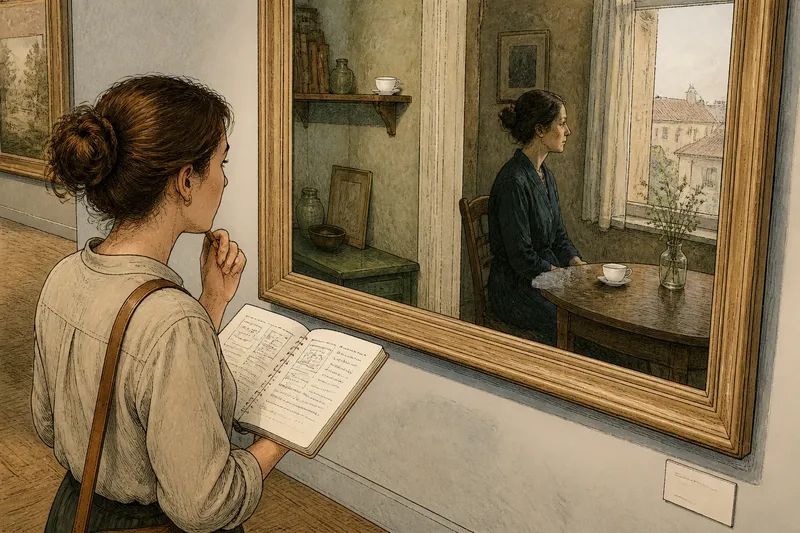
Choose a painting you can see clearly, either in a gallery or on a screen. If you are viewing a reproduction, remember that a frame, crop or screen display may conceal the actual edge. Look at all four sides before settling on a subject in the middle.
Notice whether the paint reaches the border. An even, unbroken field of colour can make the surface feel deliberate and self-contained. A pale strip or exposed ground may make the limit more conspicuous, as if the image has been carefully set inside a larger surface. Neither choice has a fixed meaning; the surrounding shapes tell you more.
Next, find the strongest forms that meet the edge. Ask whether they end there, disappear beyond it, or turn back into the picture. A shape that stops cleanly can feel bounded. One that is abruptly cut may suggest continuation outside the frame. A line that curves inward can guide the eye back towards the centre.
Follow the cropped forms
Look for objects that the border cuts through: a sleeve, tree trunk, table or patch of sky. Cropping often implies that the visible scene is part of a larger space. The viewer supplies what lies beyond, even when it is no more specific than “more room”. A carefully placed crop can make a still image feel like a moment selected from ongoing activity.
Now compare that with objects given room around them. A small figure surrounded by open ground may seem isolated, but it may also feel composed and still. The empty margin is not automatically empty in effect. It can give a subject breathing room or make its scale easier to judge.
Check the corners as well as the middle of each side. A dark patch in one corner may hold the eye inside the painting; a diagonal that runs out through the opposite edge may pull it away. These forces can coexist. The composition does not need to keep the viewer obediently in the centre, though it may make a bid for their return.
Read the surrounding space
Ask whether the painted space seems to continue beyond the canvas. Repeated forms, such as rows of windows or a band of landscape, can imply a larger arrangement outside the frame. A figure looking or reaching towards the edge can also direct attention beyond it. The painted world then feels connected to an unseen space.
Other paintings make the boundary feel firm. A central arrangement with clear margins, a level background and no cropped forms can present its subject as complete within the rectangle. The edge acts like a container, not a window. This need not make the image static: a strong shape or contrast can create plenty of movement within a tightly held boundary.
Do not confuse an open composition with a lack of design. A painting that appears to spill beyond its limits still depends on where its forms are cut and how those cuts balance the rest. Likewise, a closed composition is not simply one with no cropped objects. Its sense of completeness comes from relationships among the forms, the empty areas and the border.
Try a short looking exercise
Spend a few quiet minutes with one painting. Keep your eyes on its edges before naming the subject. Work through this sequence:
- Trace the four sides with your eyes. Note where the paint reaches the boundary and where a margin remains.
- Choose one shape that touches an edge. Decide whether it ends, continues beyond the canvas or turns back into the image.
- Compare the corners. Notice where dark and light areas appear to hold the image together or pull attention outwards.
- Look at the centre again. Ask whether the border makes the central subject feel enclosed, spacious or connected to a larger scene.
- Return to the edge that caught your attention. Decide what would change if the painting were cropped more tightly, without assuming that the imagined crop would improve it.
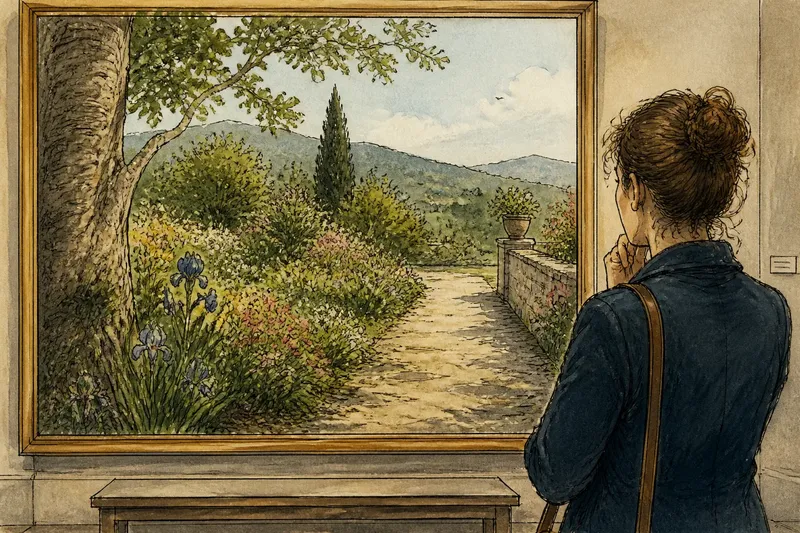
Say you are looking at a painting of a garden in which a tree trunk is cut by the left edge and a low wall ends neatly at the right. You might first read the tree as evidence that the garden continues beyond the canvas, while the wall gives the opposite side a firm stop. Returning to the whole image, you can check whether that difference makes the scene feel open, balanced or deliberately uneven. The point is not to settle on one answer but to notice what the borders ask you to imagine.
Ask about the frame?
Does the frame count as part of the painting?
The painted edge belongs to the composition; a separate frame is a later boundary around it. A frame can affect how the work is seen, but it does not change which forms the artist placed against the canvas edge.
What does a cropped figure suggest?
It often suggests that the figure continues beyond the visible area, making the scene feel like a portion of a larger space. Its effect depends on the surrounding forms: a crop may imply movement, closeness or simply an arrangement that reaches the margin.
Can a painting feel open without cropped objects?
Yes. A gaze directed beyond the picture, a receding path or repeated forms that appear to continue can extend the imagined space without cutting through a figure or object.
Why do blank margins matter?
A margin can separate the image from the canvas edge and give nearby forms room. Its shape and width in relation to the painted areas matter more than the fact that it is unpainted.
Return to the whole
After examining the border, look at the painting as a whole again. Decide whether its edges now feel like firm limits, a selection from a larger scene, or an active part of the image’s balance. The answer may differ from side to side, which is often more revealing than a single label.
When you next view a painting, let your eyes reach the canvas edge before they settle on its subject. The boundary can show you where the composition closes, where it invites the imagination outward and where it does both at once. That small shift in attention makes the painting’s rectangle visible without making it the whole story.