Before the Studio: Where Artists Worked
Artist workplaces shaped tools, working habits and encounters with viewers. Learn to read practical clues in artworks without mistaking inference for proof.
Artist workplaces shaped what could be made, how it was made and who might see it taking shape. Before the private studio became a familiar image of artistic life, makers worked in varied settings, including shared workshops, homes, court households and religious institutions. The arrangements differed across periods and places, so a workplace clue is best treated as a question rather than a universal account.
The useful question is not simply where an artist stood. It is what a particular setting allowed, restricted or demanded: which tools could stay out, how large a work could become, whether other workers were involved and how close viewers came to the process. Such clues help describe working conditions, but they do not amount to a complete biography.
Reading the workplace
Artists’ workplaces varied by period, location, social position and type of work. A painter preparing a portable panel for a patron faced different conditions from a craft worker producing objects in a busy shop. The word “studio” can flatten those differences if it suggests one stable, private room with one artist working alone.
Start with practical questions. Is the work portable or fixed in place? Does its scale suggest a large working area? Are its materials suited to repeated handling, or might they require a protected surface? None of these points identifies a workplace on its own. Together, they can help you form a cautious picture of what making the work involved.
Keep observation separate from inference. A work’s size is observable. The claim that it was made in a particular room is an inference, and a weak one unless supported by other evidence. The aim is to consider plausible conditions, not to turn an object into a floor plan.
Shared workshops
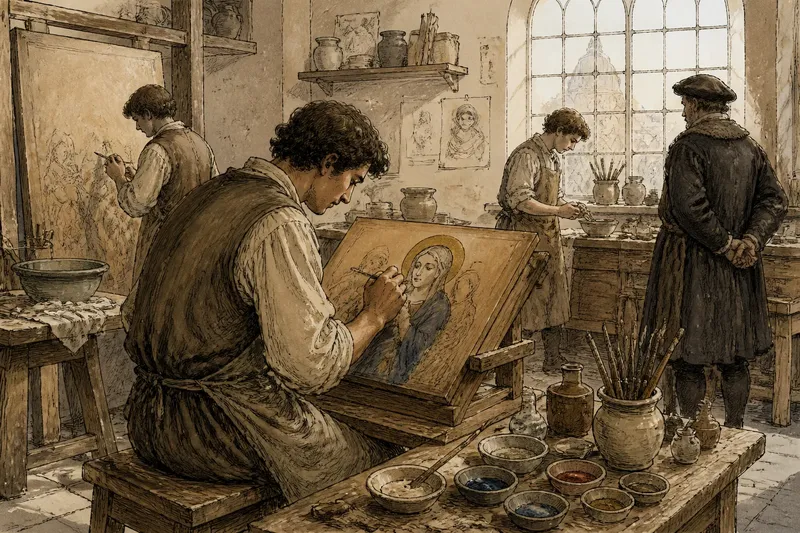
In some historical settings, a shared workshop organised production around several people, specialised tasks and common tools. An experienced maker might direct assistants or apprentices, while work passed through stages of preparation and finishing. The details depended on the workshop, its trade and its period. In such an arrangement, the name associated with an object need not mean that one person performed every task.
Shared space shaped the practical life of materials. Tools and prepared surfaces had to be accessible to more than one worker. Work in progress might be stored, moved or left for another person to continue. An object’s finish could reflect a division of labour as well as an individual hand. That possibility does not make the work less authored; it gives authorship a more complicated working context.
A workshop connected to trade could also bring customers into contact with production. Conversation, deadlines and commissions might compete with concentrated work. Other settings had different rhythms, so it is safer not to treat every workshop as either a bustling shop or a quiet room. The useful point is that production and exchange could share a space.
Domestic and court settings
Some artists made work in domestic settings, where the boundary between household and working space could be porous. A room might serve several purposes, or work might take place near family members and visitors. This could affect when materials were used, how they were stored and whether a project could remain set up between sessions.
Other makers worked under the demands of a court or institution. Access to patrons, materials and assistants could be organised around a household or official setting rather than an independent shop. Such arrangements might provide resources while tying work to schedules, protocol and the expectations of clients. The balance varied with the maker’s position and the nature of the work.
Neither “home” nor “court” describes a single experience. Avoid using a workplace label as a shortcut to a story about freedom or constraint. Ask what the specific arrangement made possible and what it required the maker to accommodate.
Private studios
A private studio is often imagined as a room set apart for one person’s concentration. A dedicated workspace could offer more control over light, tools, storage and working time. It could also make it easier to leave a large or delicate project in place rather than clear it away after each session.
Privacy could change the relationship with viewers. If customers and visitors were less likely to encounter work in progress, they might see it only after the artist chose to show it. The studio could therefore separate making from display. That separation was never automatic: patrons, assistants, students or friends might enter, and some artists worked in spaces that served other purposes too.
A private room could influence which kinds of work were practical, but it did not dictate the result. Greater control over a surface or tool does not produce a particular style by itself. It changes the conditions under which decisions are made; the artist’s choices still matter.
When clues mislead
Workplace clues can make an object feel close to its maker. A large format or carefully finished surface may invite a confident account of how the work was produced. But the same clue can fit several settings, and an object may have been moved, altered or completed elsewhere.
Say you are looking at a large painting that would be awkward to carry through a narrow doorway. You note its size and the doorway as concrete observations. You then consider whether it might have been made near its eventual display site, but also whether it could have been transported before stretching or carried through another entrance. The result is a limited answer: access and handling are worth investigating, but the painting alone does not identify the room where it was made.
A polished appearance does not show that a work was made in isolation. A shared workshop could include careful finishing, while a private studio could be crowded or interrupted. Do not assign social conditions from visual finish alone.
What can workplace clues tell you?
Did artists always work alone?
No. Some artistic production involved shared workshops, assistants or apprentices, while other arrangements were more solitary. The relevant question is how work was organised in the particular setting, not whether one hand made every mark.
Did a private studio mean complete freedom?
Not necessarily. A dedicated room could give an artist more control over materials and working time, while commissions, household needs or institutional duties still shaped the work. Privacy describes access to the space, not freedom from obligations.
Can a painting reveal where it was made?
Sometimes an object offers clues about scale, portability or handling, but these rarely identify a location by themselves. Treat them as prompts for further questions, especially when corroborating information is absent.
Why do workshop conditions matter to viewers?
They help explain how tools, labour and access may have shaped an object before it reached an audience. They also caution against assuming that every artwork began as a solitary encounter between one artist and a blank surface.
Looking with care
To use workplace history well, separate what you can see from what you suppose. Note the work’s scale, support, surface and signs of handling. Then ask which kinds of spaces could accommodate those features and what evidence might distinguish one possibility from another. A catalogue entry, a documented commission or information about the object’s original setting can provide context; the object’s appearance alone may not.
Artists’ workplaces connected materials, labour and viewers in different ways. A shared shop could bring production close to customers; a dedicated studio could keep it from view until the work was ready. When you encounter an artwork, ask who might have entered the place where it was made, who may have contributed to its production and when a viewer first became part of the process. For artist workplaces, those questions are a sounder starting point than assigning a whole social history to one brushmark.